
Welcome to another captivating discussion on our blog today, as we explore an intriguing question that you might never have considered: “Is olive oil flammable?” Olive oil, renowned for its numerous health benefits and culinary versatility, has been a staple in our kitchens for centuries. But beyond its uses in cooking and nutrition, it might just have a surprising, less-known characteristic – its flammability.
Is olive oil Flammable?
Well, it’s time to ignite your curiosity and delve into the fiery science behind this everyday ingredient. Whether you’re a professional chef, a home cook, a safety enthusiast, or just someone intrigued by the mysteries of common household items, this piece is for you. So, grab your apron (safety first!) and let’s get ready to heat things up with a deep dive into the burning question: Is olive oil flammable? Let’s find out together.
As we move forward, we’ll delve into the basic principles of flammability, compare olive oil to other commonly used oils, and, importantly, learn about the safety measures we should be aware of when using olive oil. So, let’s embark on this fascinating journey, shedding light on the lesser-known facets of a product that’s a staple in our kitchens.
Basic Principles of Flammability
Flammability might seem like a simple concept – things either catch fire or don’t, right? Flammability is a complex concept that depends on several factors. To be considered flammable, a substance must be able to ignite and sustain a fire. Key factors include the Following
- Substance’s ignition temperature
- Flash point
- Fire point
These factors are crucial in determining the flammability of a substance and have a substantial impact on its ability to catch fire.
For combustion to occur, three elements must coexist fuel (in this case, olive oil), oxygen (from the air), and heat. This trio forms the ‘fire triangle.’ Remove any of these elements to prevent or extinguish a fire.
With these basic principles in mind, let’s turn our attention back to our bottle of olive oil. Is it flammable? Let’s find out.
Is Olive Oil Flammable?
It might be a surprise, but olive oil is technically flammable. However, it doesn’t ignite as easily as substances like gasoline or alcohol. The reason lies in its ignition and flash points.
Olive oil has a relatively high flash point, around 410 degrees Fahrenheit (210 degrees Celsius). It has to be heated to this temperature to produce enough vapours to ignite in an open flame. Similarly, the ignition temperature, the temperature at which it can ignite without an open flame, is even higher.
In most kitchen scenarios, olive oil doesn’t reach these high temperatures. When you’re sautéing or frying, the oil stays well below its flash point. Therefore, while it’s technically possible for olive oil to catch fire, it’s unlikely to happen during normal cooking. However, if olive oil is left unattended on a high heat source, it can reach its flash point, and if an ignition source is nearby, it could catch fire.
| Temperature Range | Behavior of Olive Oil |
| Below 14°F (-10°C) | Solidifies and becomes cloudy |
| 14-32°F (-10 to 0°C) | Thickens and may appear semi-solid |
| 32-45°F (0 to 7°C) | Viscous and may flow slowly |
| 45-57°F (7 to 14°C) | Viscous and flows more easily |
| 57-70°F (14 to 21°C) | Olive oil is liquid |
| 70-86°F (21 to 30°C) | Olive oil remains liquid, no significant changes |
| Above 86°F (30°C) | Olive oil may start to become less stable and deteriorate |
| Boiling Point | Approximately 375-410°F (190-210°C) |
| Flashpoint | 410°F (210°C) |
| Smoke Point | Between 390-470°F (199-243°C) |
Can olive oil cause a grease fire?
Olive oil, like any other cooking oil, has the potential to cause a grease fire under certain circumstances. Grease fires occur when the oil reaches its ignition point and catches fire. Although olive oil has a relatively high smoke point and is considered stable at high temperatures, it is still susceptible to ignition if exposed to extreme heat or mishandled during cooking.
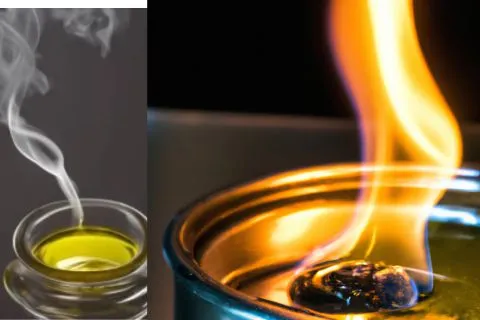
The ignition point of olive oil, also known as the flashpoint, is typically around 410°F (210°C). If the oil exceeds this temperature, it can release flammable vapors that ignite when exposed to an open flame, sparks, or high heat sources like a hot stove or oven element.
Safety Measures with Olive Oil
Knowing that olive oil is flammable under certain conditions, keeping safety in mind when using it is crucial. Here are some safety tips:
- Never leave cooking unattended, especially when using oil at high temperatures.
- Keep the heat at a reasonable level. Olive oil isn’t meant for deep-frying or other high-temperature cooking methods.
- Keep a suitable fire extinguisher in your kitchen for oil fires.
- In case of a small fire, turn off the heat source and cover the pan with a metal lid or cookie sheet to suffocate the fire.
- Avoid using water to extinguish an oil fire, as it can cause the fire to spread due to oil splattering.
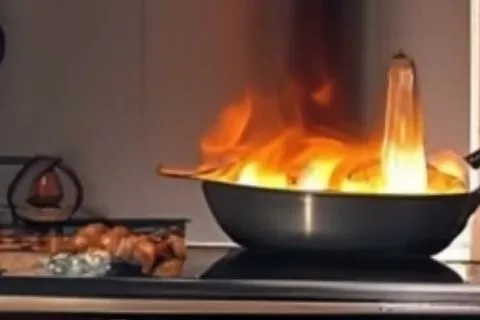
Understanding and respecting the potential flammability of olive oil and other common household substances is crucial for ensuring safety in the kitchen.
Olive Oil in Comparison to Other Cooking Oils
Now that we understand the flammability of olive oil, how does it compare to other commonly used cooking oils? Regarding flammability, most cooking oils behave similarly to olive oil, with high flash points and ignition temperatures. However, there are slight variations.
For instance, canola, sunflower, and peanut oil have slightly higher smoke points than olive oil, making them more suitable for high-temperature cooking methods like deep-frying. Conversely, flaxseed oil has a lower smoke point, making it less ideal for high-heat cooking.
Understanding that a higher smoke point does not automatically indicate that oil is safer to use is crucial. All oils, regardless of their smoke points, can catch fire if heated beyond their flash points and exposed to an ignition source.
Can olive oil catch fire in the oven?
Under normal cooking conditions, it is unlikely for olive oil to catch fire in an oven. It is because the typical baking temperatures in a home oven range from 325 to 450 degrees Fahrenheit (165 to 232 degrees Celsius), and these temperatures are generally below the flash point of olive oil.
The flash point of olive oil, which is around 410 degrees Fahrenheit (210 degrees Celsius), is the temperature at which it produces enough vapors to ignite when exposed to an open flame. However, ovens do not have an open flame inside while baking (unless it’s a gas oven with a visible flame, and even then, the flame is usually well away from the food), making ignition even less likely.

The ignition temperature of olive oil, which can ignite without an open flame, is even higher than the flash point. Therefore, olive oil will not catch fire in an oven under normal cooking circumstances.
However, if olive oil were to spill over onto the heating elements of an electric oven or the flame in a gas oven, it could ignite. The same is true if the oven temperature is set extremely high, above the flash or ignition point of the oil, which is not typical for most cooking or baking scenarios.
So, while it’s technically possible for olive oil to catch fire in an oven, it’s highly unlikely under normal cooking conditions. However, as always, it’s important to use caution when cooking or baking and never leave an oven unattended for long periods.
FAQs
Is the extra virgin olive oil extra flammable?
“Extra virgin olive oil is not more flammable than regular olive oil.” The “extra virgin” classification relates to the oil’s acidity, production process, and quality, not its flammability. Both extra virgin and regular olive oil have similar flash and ignition points, making their flammability essentially the same.
What oils are flammable?
Most, if not all, cooking oils are technically flammable, including olive oil, canola oil, sunflower oil, sesame oil, peanut oil, and others. However, these oils have high flash points (usually well above the maximum temperature of a home oven or stove), meaning they must be heated to a high temperature before igniting.
Is it safe to burn olive oil?
Burning olive oil, in the sense of using it as fuel for a lamp, is generally safe as long as it is designed for this purpose and used correctly. However, intentionally burning olive oil for other purposes, especially in a closed environment, is not recommended as it can produce smoke and potentially harmful byproducts.
What temperature does olive oil fire at?
Olive oil has a flash point of around 410 degrees Fahrenheit (210 degrees Celsius), which is the temperature at which it begins to produce enough vapor to ignite in an open flame. The ignition temperature, the point at which it can ignite without an open flame, is even higher.
Conclusion
In the journey from a humble kitchen query to a nuanced scientific exploration, we’ve discovered that olive oil, like many other cooking oils, is indeed flammable. However, under normal cooking conditions, it’s unlikely to catch fire. The key to safety lies in understanding and respecting the nature of the substances we use daily.
It’s also essential to remember that every cooking oil is unique, with its own characteristics and optimal uses. So, the next time you reach for that bottle of olive oil, you’ll appreciate it for the flavor it imparts to your dishes and the intriguing science it embodies.